Micronesia and the murky world of chequebook diplomacy
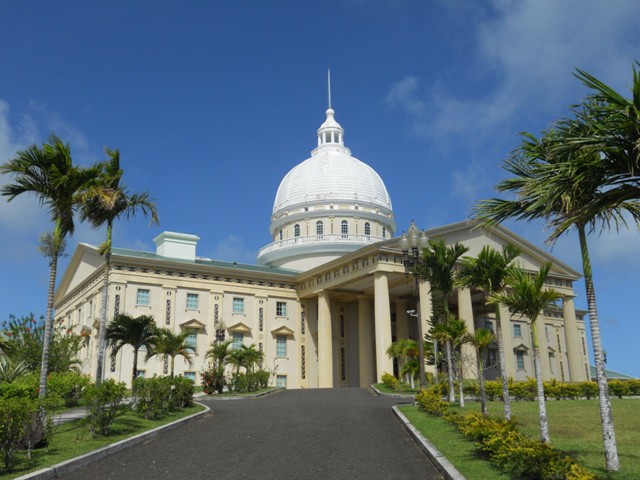
A little present from Taiwan – National Capitol Building, Melekeok, Palau
Drive up the eastern side of Palau’s main island and at a certain point you’ll see something that looks completely absurd. Having passed through several miles of lush jungle and seen a handful of modest wooden houses, from a crest in the road you’ll first spot what could easily be mistaken for the mythical land of Oz. From several miles away the enormous dome of the new Palau Capitol Building reflects the tropical sunlight, hinting that Palau’s capital Melekeok is anything but a sleepy coastal community of 150 residents.
In fact you could easily fit the entire population of Palau into the Capitol complex – several times over. This ludicrous waste of money was paid for not by the people of Palau, but by the citizens of Taiwan, some 1500 miles away. Palau is not alone in receiving these expensive gifts – the Marshall Islands capital Majuro boasts a gleaming new Taiwan-funded government building, while the State Office on the Micronesian island of Pohnpei, similarly over-sized and ill-suited for its purpose, has been provided by China. In fact across the Pacific islands generous gifts of government complexes, conference centres, airports and tarmac roads are given to willing recipient nations, most of whom are dependent entirely on foreign aid for their financial survival.
To understand why the governments of China and Taiwan are so keen to win favour in these tiny islands, you need look no further than the voting set-up in the UN General Assembly. One nation, one vote is a system that gives little Palau, with a population of 20,000, the same status as India, with a population that is an astonishing 60,000 times larger.
Imagine a poor country, producing almost nothing and entirely dependent on overseas aid. The government is considered by independent observers as corrupt, with bribery and nepotism an essential part of everyday life. Yet they hold one golden ticket – their UN vote is highly prized by countries who are fighting for recognition or support at the General Assembly. This scenario is pretty much where Micronesian nations find themselves.
China and Taiwan shower ‘their’ nations with expensive gifts. As a valued member of Team Taiwan, Palau received millions of dollars for their education funding along with new computers and software. The Federated States of Micronesia gained from a new State Office in Pohnpei along with the Micronesian capital offices at Palikir and a grand Tuna Commission Building, all part of the perks of being in Team China. Some nations have even switched sides, others have merely threatened to switch, in order to keep the cheques flowing in.
Yet Micronesian aid overwhelmingly comes from a single source. Without the financial help of the US the nations of Palau, Marshall Islands and Federated States of Micronesia would be paralysed and so it’s probably little surprise that the voting records of these three nations are almost 100% identical to that of the United States (98.7%, 97.4% and 99.1% respectively in 2009). When the Micronesian block voted with the US, Canada and Israel in the vote on recognition of Palestinian statehood, many people expressed surprise at the existence of these hitherto largely unknown nations.
For these small isolated states chequebook diplomacy is a valuable part of their income where few alternative revenue streams exist; adopting a moral stance could be very costly. China and Taiwan are very far away in every sense, while the Middle East might as well be on the moon. It is of course a suicidal position for future generations, undermining any efforts at building a long-term future that is built on good governance, transparency and self-respect. But when someone dangles a large carrot it’s hard to think beyond the short-term gains.
Visit Micronesia and you’ll find an abundance of stunningly beautiful natural resources. You’re also bound to spot the odd grotesquely palatial government building, modern office complex, new road or grand bridge. Each will bear a small plaque celebrating the friendship between the donor and the grateful recipient.
I’d like to think that in a few decades I will return to Micronesia and see more new buildings and transport projects. They’ll have plaques next to them, just like the current ones. But they will read slightly differently: “This project was funded entirely by the government, with funds generated by our trade with overseas partners and tax revenues from successful island businesses.” I’m not optimistic.


Post a Comment